
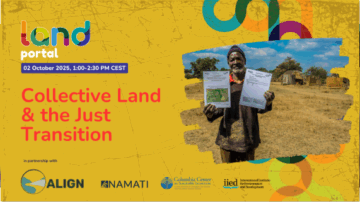
The Collective Land and the Just Transition webinar was the seventh in the Advancing Land-based Investment Governance (ALIGN) series, which explores practical strategies for improving the governance of land-based investments in the Global South. This session focused on how collective land tenure intersects with the just transition agenda—highlighting both opportunities and tensions as countries move to implement renewable energy, reforestation, and conservation projects.
Moderator Nathaniah Jacobs (IIED) opened the session by emphasizing that a “just transition” must be socially legitimate, rights-based, and inclusive, encompassing distributive, procedural, and restorative justice. Many climate actions, she noted, require large tracts of land, often overlapping with collectively held territories. This reality raises urgent questions: How are collective land rights recognized and protected? Who decides on land use? What happens when customary and formal governance systems collide?
Several hundred participants joined from around the world, with interpretation offered in Bahasa Indonesia, French, Portuguese, and Spanish.
Whose Land Powers the Transition?
As countries move to implement concrete actions to deliver a climate responsive transition from renewable energy to reforestation and conservation—collectively held lands are increasingly at the center of proposed solutions. But how are these lands governed? Who decides how they are used? And what happens when customary institutions and formal governance systems collide?
See the replay of the ALIGN webinar on October 2, 2025 to unpack the opportunities and tensions that collective land tenure brings to the just transition agenda, as well as the concrete strategies being adopted in response.
The speakers told how traditional authorities, community organizations, and civil society leaders are working at the frontlines of land governance and climate action. The webinar explored :
- How competing land uses are balanced in transition planning
- The role and duties of customary institutions
- Strategies to ensure meaningful participation and consent
Key Messages for Decision-Makers
Each speaker offered closing reflections on what governments and policymakers must consider when collective lands are at stake:
- Wilmien Wicomb: “Communities are not monolithic. Developers must identify and consult all rightsholders, not just leaders. The onus is on them to understand whose rights they are affecting.”
- Siyabu Manona: “We need a land administration system that recognizes different kinds of rights, not just those that fit a Western grid. Without reliable data and recognition, consultation and consent are impossible.”
- Imam Hanafi: “Recognition must go hand in hand with respect for customary governance and participatory mapping as credible spatial evidence. Climate targets cannot override community rights.”
- Jimmy Ochom: “A just transition must not deepen inequalities. Customary and collective rights should be legally protected; FPIC and fair compensation must be mandatory; and gender and youth inclusion are essential.”
Rejoignez-nous sur
LinkedIn