
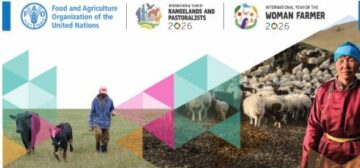
18 February 2026 |10.00 – 11.30 (CET)
| Join us for the fourth webinar organised by the Global Agenda for Sustainable Livestock (GASL), together with its broader network of partners, to support the International Year of Rangelands and Pastoralists and the International Year of the Woman Farmer in 2026. Pastoralism plays a crucial, global role by sustaining vast human populations, delivering essential ecological services, preserving rangelands, and significantly bolstering the subsistence economy in some of the world’s most impoverished regions. However, agricultural expansion, industrial development, climate change, and shifts toward sedentary livestock systems have reduced the role of traditional pastoralism. Ongoing global changes, and perceptions of pastoralism as environmentally and economically inefficient, continue to challenge pastoral communities and limit investment. This webinar synthesizes cutting-edge evidence on pastoralism as an ecological, economic, and social solution to current development challenges. It brings together researchers, policymakers, development practitioners, and pastoralist representatives to synthesize the evidence, examine policy gaps, and develop future research priorities. For more information visit our website!
Agenda Moderator: Tahira Mohamed, ILRI 10:00-10:05 – Opening remarks and scene setting – Moderator & Hsin Huang, GASL chair 10:05-10:15 – High-level presentation – Sarah Ossiya, AU-IBAR (TBC) 10:15- 10:55 Thematic presentations. Targeting evidence that needs to be uptake by policy makers. 1. Are livestock products part of healthy diets? – Stella Nordhagen, GAIN 2. Climate change and the ecological dynamics of pastoralism: debunking climate change and myth around climate variability in pastoral context – Pablo Manzano, Basque Centre for Climate Change 3. Pastoralism and institutions: state, infrastructure, development policies and the vulnerability narrative as the engine for pastoral development – Samuel Derbyshire, ILRI 4. Mobility, collective governance and the relational resilience: rethinking governance policies in pastoral systems through a relational lens. Australian funded research on resilience in Ethiopia and Kenya – Rahma Hassan, Centre for Research and Development in Drylands and Tufts University
10:55-11:20: Interactive discussions & Q&A Bridging evidence and policy – Moderated discussion with panelists – Policy makers · Zoewinde Bouda , FAO GEF Great Green Wall · Henk Jan Ormel, Dutch Competent Authority for Animal Procedures (TBC) · Lauren Lecuyer, Bern University 11:20-11:25 Reflection by the webinar harvester – Moderator 11:25-11:30 Closing – Camillo De Camillis, GASL Coordinator
UPCOMING WEBINARS:
The role of women and youth in pastoralism.
Science-based communication on the multifunctionality of pastoral systems / livestock grazing systems for policy and action.
Silvopastoral systems for sustainable livestock transformation.
|
Rejoignez-nous sur
LinkedIn